
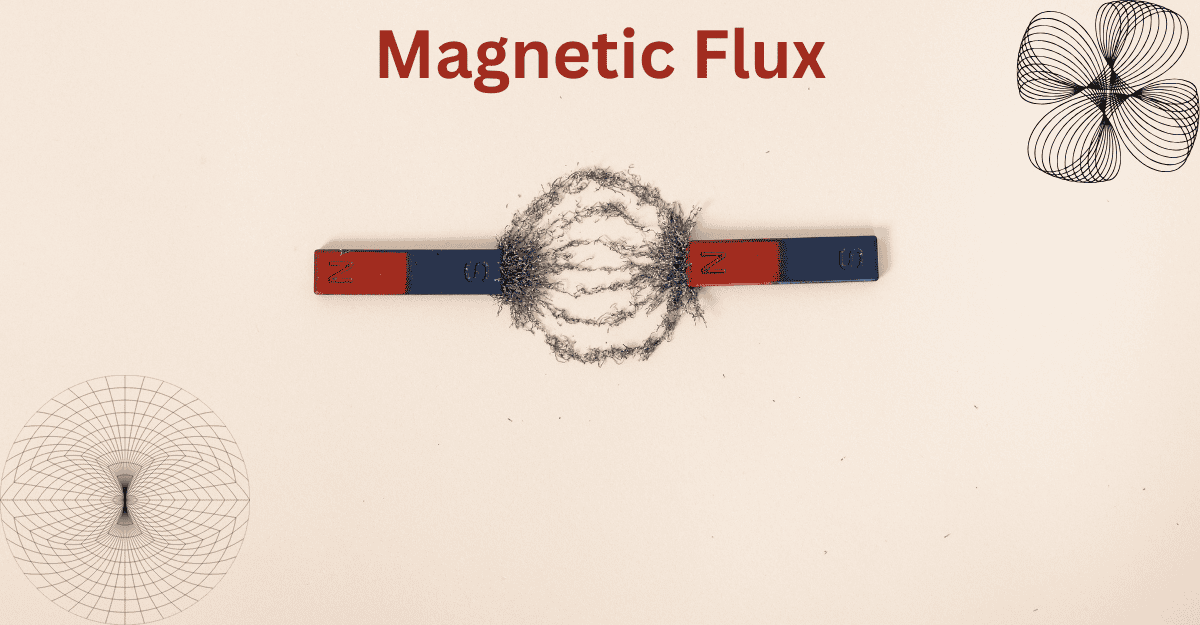
Magnetic flux measures the magnetic field passing through a given surface. For a uniform magnetic field and a flat surface:
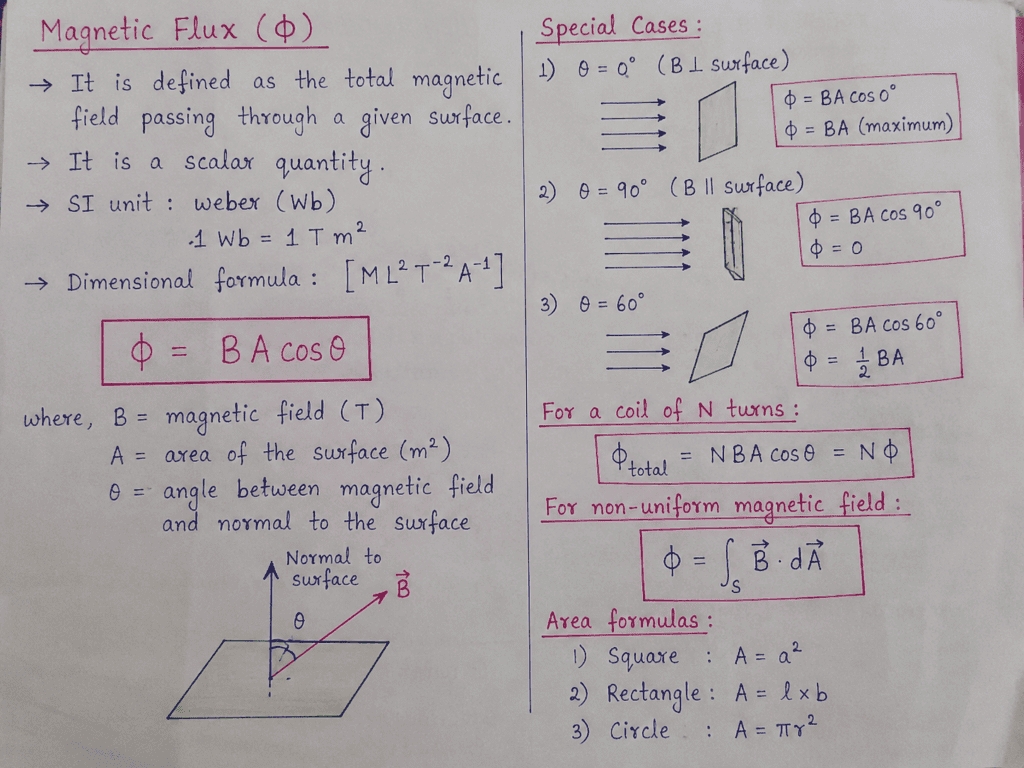
ΦB = B A cos θ
B = magnetic field (tesla, T); A = area (m²); θ = angle between the magnetic field and the surface normal. SI unit: weber (Wb); 1 Wb = 1 T·m². Magnetic flux is a scalar and may be positive, negative, or zero.
For a non-uniform field: ΦB = ∫ B · dA. Dimensional formula: [M L² T⁻² I⁻¹].
Important Cases of magnetic flux
- θ = 0°: ΦB = BA (maximum positive flux; field perpendicular to the surface).
- θ = 90°: ΦB = 0 (field parallel to the surface).
- θ = 60°: ΦB = BA/2.
- θ = 180°: ΦB = −BA (normal opposite to the field).
Remember: θ is measured from the normal to the surface, NOT from the plane of the surface.
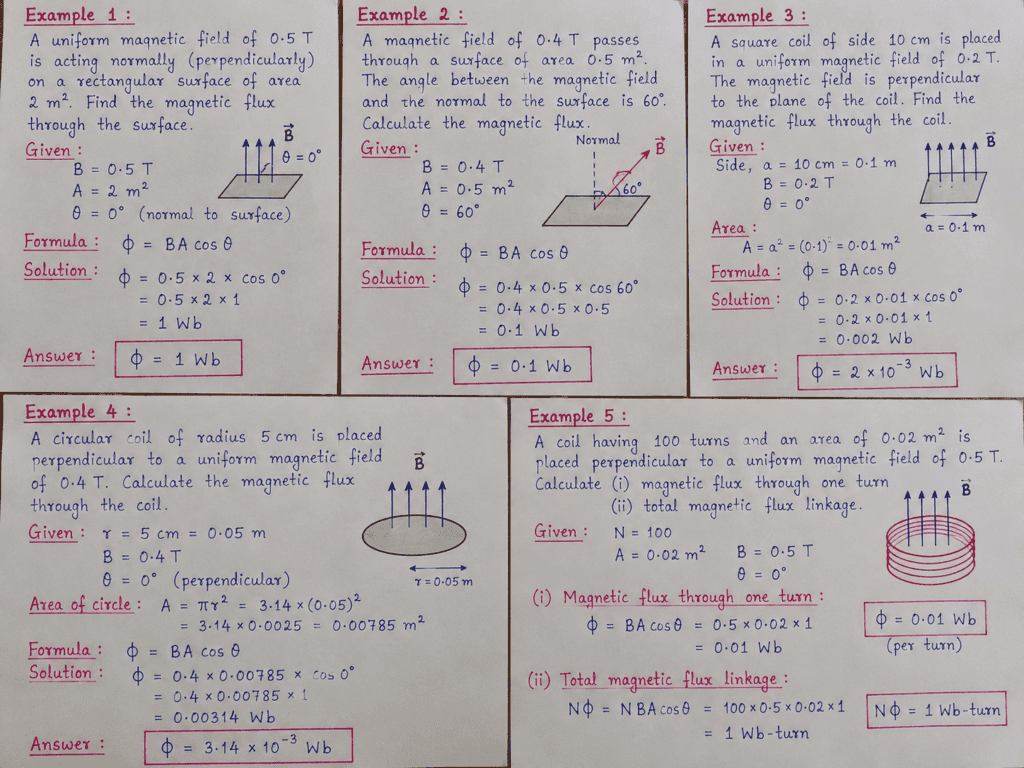
Important Definition and Numerical Example
A. Basic Facts About Magnetic Flux
- Magnetic flux measures the total magnetic field passing through a given surface.
- Magnetic flux is represented by the Greek letter Φ (Phi).
- The SI unit of magnetic flux is the weber (Wb).
- Magnetic flux is a scalar quantity.
- The formula for magnetic flux is Φ = BA cos θ for a uniform magnetic field and a plane surface.
- The dimensional formula of magnetic flux is [ML²T⁻²I⁻¹].
- One Weber is equal to one tesla-meter squared (1 Wb = 1 T · m²).
- The CGS unit of magnetic flux is the Maxwell (Mx).
- 1 Weber = 10⁸ Maxwell.
- Magnetic flux can be positive, negative, or zero depending on the chosen surface normal.
Also Read: 5 stages of Freud’s Psychosexual Theory in children
B. Important Facts About Magnetic Flux and Angles
- Magnetic flux is maximum when the magnetic field is perpendicular to the surface.
- Magnetic flux is zero when the magnetic field is parallel to the surface.
- When θ = 0°, magnetic flux is Φ = BA.
- When θ = 90°, magnetic flux is Φ = 0.
- When θ = 60°, magnetic flux is Φ = BA/2.
- When θ = 30°, magnetic flux is Φ = √3BA/2.
- When θ = 45°, magnetic flux is Φ = BA/√2.
- When θ = 180°, magnetic flux is Φ = −BA.
- The angle θ is measured between the magnetic field and the surface normal.
- Magnetic flux depends on magnetic field strength, surface area, and orientation.
C. Magnetic Flux and Electromagnetic Induction
- Michael Faraday discovered electromagnetic induction in 1831.
- Electromagnetic induction is the production of EMF due to a change in magnetic flux linkage.
- Faraday’s first law states that a changing magnetic flux linkage induces an EMF in a circuit.
- Faraday’s second law states that induced EMF is equal to the negative rate of change of magnetic flux linkage.
- The mathematical expression of Faraday’s law is ε = −N(dΦ/dt) for a coil of N turns with equal flux through each turn.
- The negative sign in Faraday’s law represents Lenz’s law.
- Lenz’s law states that induced current opposes the change in magnetic flux responsible for its production.
- The SI unit of induced EMF is the volt (V).
- One Volt is equal to one Weber per second (1 V = 1 Wb/s).
- A changing magnetic flux can induce EMF even without direct contact between a magnet and a coil.
D. Magnetic Flux and Magnetic Field
- Magnetic flux density is represented by B.
- The SI unit of magnetic flux density is the tesla (T).
- 1 Tesla = 1 Weber/m².
- The CGS unit of magnetic flux density is Gauss (G).
- 1 Tesla = 10⁴ Gauss.
- Magnetic field lines form continuous closed loops.
- Magnetic field lines never intersect each other.
- The magnetic field is stronger where magnetic field lines are closer together.
- The net magnetic flux through any closed surface is always zero.
- Gauss’s law for magnetism is expressed as ∮ B · dA = 0.
E. Magnetic Flux and Practical Applications
- An electric generator works on the principle of electromagnetic induction.
- A transformer works on the principle of mutual induction.
- An electric generator converts mechanical energy into electrical energy.
- A transformer changes AC voltage through electromagnetic induction.
- Eddy currents are circulating currents induced in conducting materials by changing magnetic flux.
- Eddy currents are used in electromagnetic braking systems.
- Laminated transformer cores help reduce energy losses due to eddy currents.
- Magnetic flux linkage for a coil of N identical turns is NΦ.
- The SI unit of magnetic flux linkage is Weber-turn (Wb-turn).
- The induced EMF increases when the rate of change of magnetic flux linkage increases.